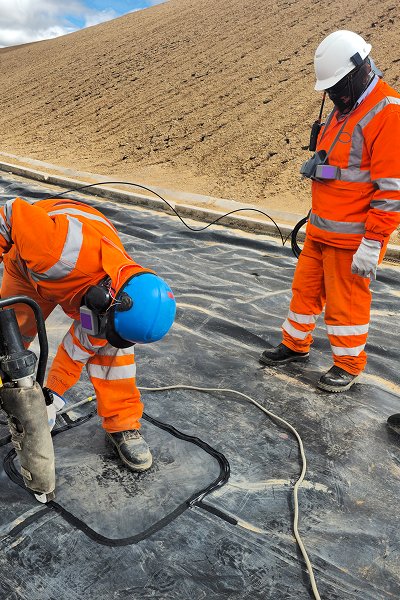

Geotube Construction Process – Silt Solidification, Dredging and Dewatering, and Coastal Protection Engineering
Geotubes (also known as geobags or dewatering tubes) are large-capacity dewatering and solidification devices that have been widely used in recent years for projects such as river dredging, port dredging, tailings dewatering, polluted sludge treatment, coastal protection, and dam reinforcement.
Their core advantages include: high dewatering efficiency, convenient construction, environmental friendliness, low cost, and suitability for large-scale sludge treatment.
What is a geotube bag and what is its function?
Sludge Dewatering and Solidification: Sludge with a moisture content exceeding 90% is injected into geotube, where gravity and pressure drain the sludge, ultimately forming a stable solid.
Dredging Engineering Applications: Sludge from rivers, lakes, ports, and reservoirs can be directly pumped into geotextile bags, reducing the number of times it needs to be transported.
Coastal Protection (Dike Structures): Large geotextile bags can serve as "flexible dikes" for dike construction, erosion control, and coastal erosion mitigation.
Tailings and Industrial Sludge Treatment: Used in the mining and chemical industries for rapid solid-liquid separation, improving tailings dam safety.
Environmental Remediation:Used for the safe storage and dewatering of polluted sediment, reducing the risk of spread.
Geotube, due to their advantages of rapid construction, low cost, environmental friendliness, and high dewatering efficiency, have become a core material in modern water conservancy, marine engineering, and environmental remediation projects. Whether it's long-distance river dredging, port dredging and reduction, black and smelly river treatment, or coastal protection and emergency leak sealing, Geotube can provide efficient and reliable solutions.
Tube bag unfolding method
Crane lifting (for seawalls and ports)
Manual and trailer-assisted deployment (for onshore construction)
Dragging on the ground is prohibited / Must be laid straight along the laid-out axis / Inspect for wrinkles and twists after deployment
Water Inlet (Feed Inlet) Preparation
Common Configuration:
One feed inlet every 10–15m
Diameter: 30cm or 40cm
Installation Procedure:
Open the PP flange at the top of the tubing bag
Insert the pump tubing 30–50cm
Tighten with external straps
To prevent leakage or erosion of the tubing inlet
Staged filling (the most critical step in geotube construction)
Phase 1 (Preliminary Filling: Shaping)
Initial fill height: 30–50 cm (small tubular bags)
Initial fill height is approximately 30–40% of the design height.
Function:
Forms the tubular bag shell/Provides the subsequent pressure-bearing profile.
Pressure control:
Cannot exceed the material's ultimate tensile strength/R750 strength. Typical allowable pressure < 70 kPa
Phase Two (Continuous Filling: Dehydration in Progress)
After Phase One, the tubing will begin to dehydrate naturally.
Characteristics of this phase:
Uniform filling is required to avoid bulging on one side.
Real-time monitoring of the tubing height is necessary.
Sufficient dehydration must be ensured after each injection.
Dehydration Time:
Initial dehydration: 24–72 hours / Complete dehydration: 1–4 weeks (depending on moisture content)
Phase 3 (Final Filling: Raising to Design Height)
The final height must be controlled for all projects:
100% of the design height / If settlement is significant, fill to 110%
Final Filling Notes:
Each filling volume should not exceed 20-30% of the bag's capacity / If bulging occurs, filling should be stopped immediately.
Phase 5: Dehydration Management
Dehydration methods include:
Gravity dehydration (most common) / Chemical dehydration (flocculators PAM/PAC) / Solar thermal evaporation assistance
Flocculator addition methods:
Set up a mixing tank / Use a static mixer / Control the dosage 1–5‰ / Promote rapid sedimentation
During natural dehydration, observe:
Whether the outlet is unobstructed / Whether the water quality is clear and transparent / Whether the tubing is excessively bulging
Stage Six: Repeated Filling and Stabilization
Geotextile bags often require 2–5 filling cycles.
Before each filling cycle, it is essential to:
Check the bag height/assess settlement/confirm sufficient dewatering
Confirm the absence of new cracks and tears
Once the height reaches the design value:
Enter the "stabilization period," generally observed for 2–7 days
Finally solidify to form a stable dam or dewatered body.


Geotubes, as the most widely used dewatering and solidification technology in modern water conservancy, environmental protection, and coastal engineering, rely on "standardized layout, segmented filling, strict pressure control, thorough dewatering, and stable shaping" as their core construction method.
The standard construction process includes: construction preparation, foundation treatment, geotube layout, fixing and positioning, pump pipe connection, segmented filling, natural dewatering with flocculant assistance, multiple fillings, and final shaping.
By strictly following the process, geotubes can achieve:
Highly efficient dewatering and solidification of silt
Reduced transportation costs and environmental pressure
Improved structural stability of coastlines and dikes
Accelerated river dredging and tailings reduction