
Why Highway Base Courses Require Reinforcement
The highway base course functions as the primary load-transfer layer between the pavement surface and the subgrade. Every passing vehicle generates vertical and horizontal stresses that gradually deteriorate the pavement structure if the foundation lacks sufficient strength.
Several common engineering problems make reinforcement necessary.
1. Weak Bearing Capacity of Soft Subgrades
Many highways are constructed across soft clay, silt, reclaimed land, or floodplain soils with naturally low bearing capacity.
Typical issues include:
Excessive compression
Differential settlement
Reduced pavement stability
Premature structural deformation
Without reinforcement, these weak soils often require expensive excavation or thick replacement layers.
2. Continuous Heavy Traffic Loading
Modern highways experience millions of load cycles throughout their service life.
Repeated truck traffic gradually causes:
Fatigue cracking
Aggregate displacement
Base layer loosening
Permanent deformation
As traffic volumes continue to grow, conventional granular bases alone often become insufficient.
3. Water-Induced Structural Damage
Rainwater infiltration remains one of the leading causes of pavement deterioration.
When water enters the base layer, it may:
Reduce soil strength
Wash away fine particles
Increase pore water pressure
Accelerate pavement failure
Effective reinforcement helps maintain structural integrity even under wet conditions.
4. Lateral Movement of Granular Materials
Traditional crushed stone bases rely mainly on compaction.
Over time, aggregates tend to move sideways under repeated traffic loading, resulting in:
Rutting
Surface depressions
Edge failures
Uneven settlement
Controlling this lateral displacement is essential for long-term pavement performance.
How Geocell Reinforcement Works
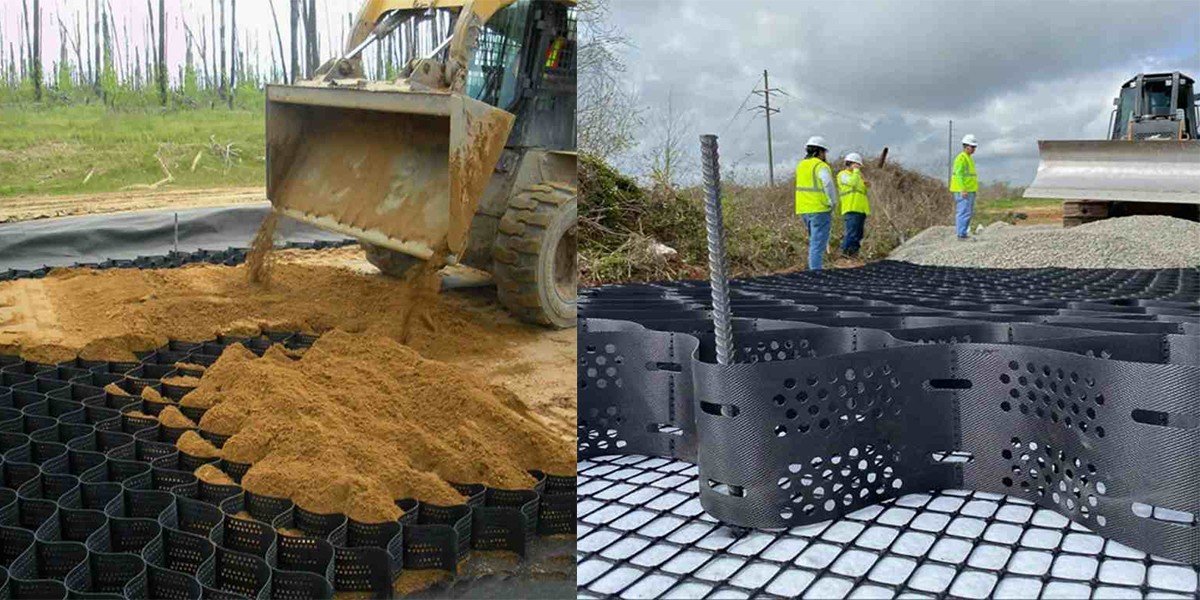
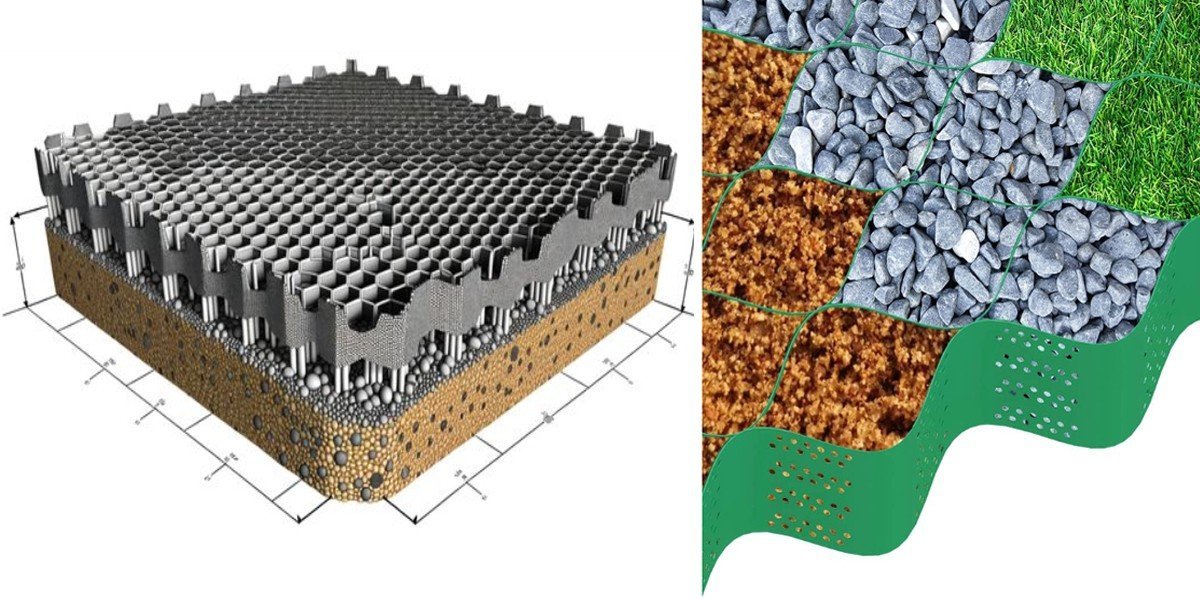
Unlike traditional reinforcement methods, geocells use a three-dimensional honeycomb structure to confine granular materials, creating a mechanically stabilized composite layer.
This engineering principle significantly improves pavement performance while reducing material consumption.
Three-Dimensional Confinement
Each geocell compartment restricts the horizontal movement of gravel, crushed stone, or sand.
This confinement creates a highly stable internal structure where aggregates interlock under loading instead of spreading laterally.
As a result:
Aggregate migration is minimized
Load transfer becomes more efficient
Structural stability improves significantly
Vertical Load Distribution
Vehicle wheel loads are dispersed through the geocell network rather than being concentrated directly beneath the tire.
The result is:
Point loads become distributed loads
Localized stresses are reduced
Pressure on the subgrade decreases
Settlement is minimized
This wider stress distribution greatly improves pavement performance over weak soils.
Improved Shear Resistance
The confined aggregate forms a strong interlocking system inside each geocell.
Compared with unreinforced granular layers, the reinforced base exhibits:
Higher shear strength
Better resistance to displacement
Improved structural integrity
Greater resistance to cyclic loading
Increased Overall Structural Stiffness
Once filled and compacted, the geocell layer behaves similarly to a semi-rigid slab.
This composite structure helps:
Reduce pavement deflection
Improve load-bearing performance
Enhance long-term durability
Lower maintenance frequency
Typical Highway Pavement Structure with Geocell Reinforcement
A standard highway pavement system using geocells generally consists of the following layers:
Asphalt Surface Course
↓

Granular Base Layer (Geocell Reinforced)
↓

Granular Subbase
↓

Prepared Subgrade
The geocell layer is typically installed within the base course where confinement provides the greatest structural benefit.
Common Highway Applications
Soft Ground Improvement
In soft soil regions, geocells are placed directly over the prepared foundation and filled with crushed stone.
This method helps:
Increase bearing capacity
Reduce settlement
Improve construction efficiency
Minimize excavation requirements
Reinforced Granular Base Courses
Traditional granular bases often require greater thickness to achieve the desired performance.
With geocell confinement:
Aggregate remains locked in position
Base thickness may be reduced
Material efficiency increases
Long-term deformation decreases
Heavy-Duty Transportation Corridors
Geocells are widely used in roads subjected to intensive truck traffic, including:
Freight highways
Logistics parks
Port access roads
Industrial transportation routes
Their improved load distribution helps reduce rutting while extending pavement service life.
High Embankment Construction
For highways crossing mountainous terrain or high embankments, geocells enhance overall slope stability by reducing differential settlement and improving the integrity of the foundation system.
Comparison with Conventional Base Reinforcement Methods
| Reinforcement Method | Structural Strength | Construction Cost | Installation Speed | Long-Term Durability |
|---|---|---|---|---|
| HDPE Geocell System | High | Medium | Fast | High |
| Thick Granular Base | Medium | Medium | Medium | Medium |
| Cement-Stabilized Base | High | High | Slow | High |
For many highway projects, geocells provide an effective balance between engineering performance, construction efficiency, and life-cycle cost.
Suitable Highway Projects for Geocell Reinforcement
Geocell technology is particularly beneficial under challenging ground conditions where traditional solutions become expensive or difficult to construct.
Typical applications include:
Soft Ground Highways
Coastal highways
Floodplain roads
Reclaimed land
Wetland infrastructure
Heavy Traffic Routes
National freight corridors
Port access roads
Mining haul roads
Industrial transportation networks
Mountainous Infrastructure
High embankments
Uneven geological formations
Slope stabilization projects
Highway Rehabilitation
Pavement strengthening
Base course rehabilitation
Road widening projects
Pavement life extension
Industry Outlook
As transportation authorities continue to prioritize longer pavement life and lower maintenance costs, mechanically stabilized pavement systems are becoming increasingly important in modern highway engineering.
HDPE geocells provide an efficient solution by combining three-dimensional confinement with improved load distribution, allowing highway base courses to perform more effectively under heavy traffic and difficult ground conditions.
Compared with conventional reinforcement methods, geocell systems offer significant advantages in reducing rutting, controlling settlement, improving structural stability, and optimizing construction costs. These benefits have led to growing adoption across highway, airport, railway, mining, and industrial infrastructure projects worldwide.
For engineers seeking sustainable pavement reinforcement solutions, geocell technology is expected to remain an important component of future road construction and rehabilitation projects.