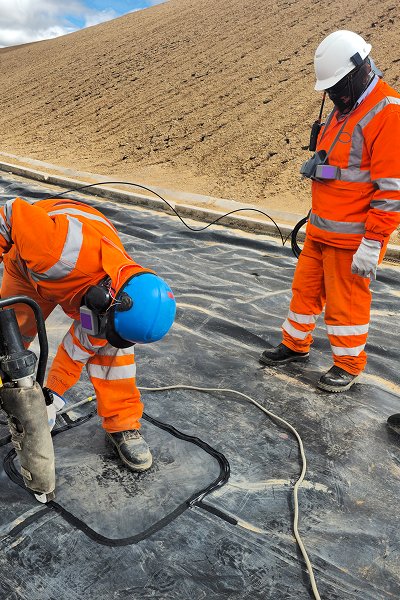

How to choose the appropriate geocell height and welding distance?
The height and welding distance of geocells are the two most critical technical parameters.
Geocells are widely used in:
Highway and railway subgrade reinforcement
Soft soil foundation treatment
Slope protection engineering
River and coastal protection
Parking lot and temporary road construction
Due to their excellent lateral restraint capabilities, geocells can significantly improve soil bearing capacity and reduce settlement.
Geocell height is one of the most important technical parameters when selecting a geocell for engineering applications. It directly affects the confinement strength, load distribution, and overall stability of the reinforced layer. A higher geocell provides deeper confinement for the infill material, which improves the ability of the system to resist lateral movement and increases the bearing capacity of the soil.
In practical engineering projects, geocell heights are typically available in several standard sizes, including 50 mm, 75 mm, 100 mm, 150 mm, and 200 mm. Each height is designed for different applications. For example, lower heights are often used for landscaping or light-duty applications, while higher geocells are commonly used in road construction, slope protection, and heavy-load ground stabilization projects.

The welding distance is a critical parameter because it directly influences the performance of the geocell system. When the cells are filled with materials such as soil, sand, or gravel, the welded structure provides lateral confinement, preventing the infill material from spreading outward under load. The spacing between welds affects how effectively this confinement works.
Common geocell welding distances used in engineering projects include 330 mm, 356 mm, 400 mm, 445 mm, and 660 mm. Smaller welding distances are typically used in projects that require stronger soil confinement and higher load-bearing performance, such as road base reinforcement and heavy-duty pavement structures. Larger welding distances are often used in slope protection or erosion control applications where flexibility and coverage area are more important than maximum load capacity.

Relationship between geocell height and welding distance
For example, lower geocell heights such as 50 mm or 75 mm are usually paired with smaller welding distances, such as 330 mm or 356 mm. This configuration creates smaller and denser cells, which helps maintain sufficient lateral confinement despite the shallow cell depth. On the other hand, higher geocells—such as 150 mm or 200 mm—can be combined with larger welding distances like 400 mm or 445 mm because the greater height already provides stronger confinement to the fill material.
The relationship between these two parameters also affects material efficiency and project cost. Smaller welding distances increase the number of cells per unit area, which improves confinement but requires more material and manufacturing effort. Larger welding distances reduce the number of cells and can lower costs, but they must be carefully matched with sufficient geocell height to maintain stability.
Typical International Specification Combinations
| Height | Welding Distance | Sheet Thickness |
|---|---|---|
| 75 mm | 356 mm | 1.1 mm |
| 100 mm | 356 mm | 1.2 mm |
| 100 mm | 400 mm | 1.2 mm |
| 150 mm | 400 mm | 1.5 mm |
| 200 mm | 445 mm | 1.6 mm |
Conclusion
Selecting the appropriate geocell specification is a crucial step in ensuring the success and long-term performance of soil stabilization and reinforcement projects. Among the various parameters, geocell height and welding distance play a particularly important role in determining the structural strength, load distribution, and confinement performance of the geocell system.
Geocell height directly influences the depth of confinement and the amount of infill material that can be contained within each cell. Higher geocells generally provide stronger vertical support and improved load-bearing capacity, making them suitable for heavy-duty applications such as road construction, railway subgrades, and soft soil stabilization. Lower heights, on the other hand, are often sufficient for light-load projects such as landscaping, parking areas, and pedestrian pathways.