
Why compare PP geotextile bags and PET geotextile bags ?
Geobags are used as reinforcement and ecological protection materials in geotechnical engineering projects such as river regulation, slope protection and greening, coastal protection, dam reinforcement, and silt consolidation. Among all geobag materials, PP (polypropylene) and PET (polyester) are the two most widely used raw materials.


Different Materials → Significant Performance Differences
PP and PET differ in molecular structure, mechanical properties, durability, elongation at break, and chemical resistance, directly affecting the following aspects of geotextile bags during use:
Tensile strength/deformation control/erosion resistance/acid and alkali resistance/service life
Different application scenarios → Choosing the wrong material may lead to project failure
River or seawall erosion projects → PET is more resistant to creep and has less deformation
Greening eco-bags → PP is softer, more permeable, and easier to mold
Acidic and alkaline environments → PP is more resistant to chemical corrosion
Temporary projects with limited budgets → PP is more economical
Core Differences Summary: PP Geobag vs PET Geobag
| Comparison Item | PP Geobag (Polypropylene) | PET Geobag (Polyester) |
|---|---|---|
| Raw Material | Polypropylene (PP) | Polyester (PET) |
| Tensile Strength | Medium to high | Higher tensile strength |
| Elongation at Break | Higher, more flexible | Lower, stiffer, controlled deformation |
| Creep Resistance (Long-term deformation) | Moderate | Excellent, long-term stable |
| Chemical Resistance | Very good chemical resistance, especially to acids and alkalis | Sensitive to strong alkalis |
| UV Resistance | Medium (requires UV stabilization) | Medium (requires UV stabilization) |
| Durability | Good for short- and mid-term projects | Better for long-term, permanent structures |
| Abrasion / Installation Resistance | More flexible and resistant to installation damage | Requires more careful handling |
| Cost | Lower cost | Slightly higher cost |
| Water Permeability | Good (depends on fabric type) | Good (depends on fabric type) |
| Typical Lifespan | Medium (depends on UV & additives) | Long lifespan, better structural stability |
| Best Application Areas | Landscaping, vegetation bags, temporary works, chemically aggressive soils | Slope protection, riverbank reinforcement, coastal engineering, long-term load-bearing projects |
Performance Comparison: Which is More Suitable for Your Project ?
Tensile strength and load-bearing capacity: PET > PP
PET (polyester) itself has higher molecular strength, making it more suitable for projects with high load-bearing capacity, steep slopes, and high erosion risk.
It is also safer for applications requiring high long-term stability (dams, seawalls, retaining walls).
Elongation at break: PP is softer and easier to work with.
PP's high elongation at break better absorbs stress concentration caused by sharp sand and gravel, making it less prone to tearing and easier to fill, stack, and transport.
Long-term creep performance: PET is significantly better than PP
Creep determines the long-term load-bearing capacity and deformation controllability of geomaterials.
PET has lower creep → suitable for 20–50 year long-term structures
PP will exhibit more significant deformation under long-term loads.
Chemical stability: PP is more suitable for areas with complex chemical environments.
PP has stronger resistance to acids and alkalis, making it particularly suitable for:
Near landfill leachate
Industrial wastewater channels
Environments with large fluctuations in soil pH.
UV resistance: Both rely on additives.
Virgin PP and PET are not UV resistant and require:
UV-resistant additives (such as UV stabilizers)
Thickened nonwoven structure
Appropriate soil covering
Construction and Operability (Laying, Sealing, Welding)
Operating Weight and Roll Volume
PP has low density and is lightweight, resulting in a large volume of roll material per unit area (more volumetric fibers per grammage), facilitating manual laying and rapid on-site deployment.
Heat Welding/Seaming
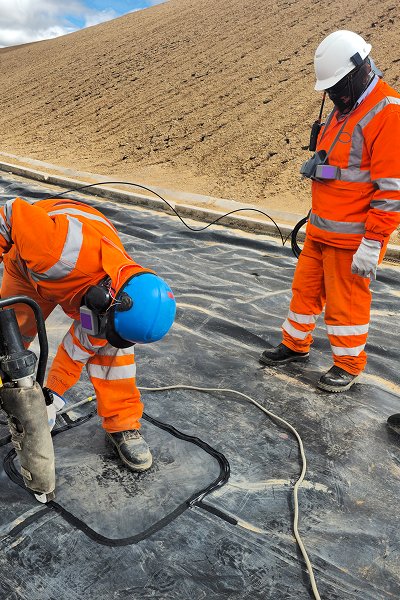
PP materials generally have good heat-melting properties (melting point lower than PET), making on-site heat fusion or ultrasonic welding convenient; PET has a high melting point, requiring higher temperatures or seaming/bonding processes for welding.
On-Site Damage Resistance
As mentioned earlier, PP's flexibility makes it more resistant to construction damage in filling/stacking/friction environments; PET is more brittle and requires more careful construction protection.
Typical Engineering Applications and Recommendations
Sludge Dewatering/Short-Term Containment (Temporary Projects): PP is preferred (low cost, easy construction, resistance to installation damage).
Long-Term Seawall/Riverbank Protection (Exposed/Salt Spray Environment): Depends on the chemical medium: If seawater/salt content requires long-term weather resistance, choose UV-stabilized PP or apply surface protection; if long-term load-bearing and deformation control are required, PET is more reliable (but pay attention to UV protection and stitching treatment).
Road/Railway Subgrade Reinforcement (Long-Term Load-Bearing): PET is preferred (low creep, high modulus).
Lenzip Industrial Zipper
Industrial Wastewater/Chemical Scenarios (Strong Acids and Alkalis): PP is preferred (good chemical stability), but the specific chemical medium needs to be verified.


Conclusion
Choosing between PP geotextile bags and PET geotextile bags ultimately depends on the specific needs of your engineering project. PP geotextile bags are ideal for applications requiring excellent chemical resistance, cost efficiency and lightweight handling. They perform well in environments with high acidity, alkalinity or salt exposure, making them a practical choice for coastal protection, sludge dewatering and temporary containment works.
On the other hand, PET geotextile bags offer superior long-term strength, UV resistance and dimensional stability, making them the better option for permanent structures such as riverbanks, retaining walls, reinforcement layers and environmental protection projects that demand high durability over decades.
In short:
Choose PP bags when you need economical, chemically stable and easy-to-install solutions.
Choose PET bags when your project requires high tensile strength, long service life and strong resistance to UV and creep deformation.
By understanding these differences and matching them with your engineering requirements, you can confidently select the most suitable geotextile bag material to maximize project performance, safety and lifespan.