
-
Geotube
-
Geogrid
-
Nonwoven Geotextile
-
Woven Geotexitle
-
Nonwoven Geo Bag
-
Geosynthetics Clay Liner
-
Anti Grass Cloth
-
Plastic Grass Grid
-
Drainage Board
-
Adjustable Pedestal
-
Composite Geomembrane
-
Water storage module
-
EPDM geomembrane
-
Tarpaulin
-
Drainage Cell
-
Road Crack Sealing Tape
-
Geographic Grid
-
Geomembrane welding machine
-
Three Dimensional Geomat
-
Composite Geonet
-
Asphalt cold patch
-
HDPE Geocell
-
Geomembrane


Property | Test Method (ASTM) | Unit | Typical Value Range | |||||
Tensile Strength | ASTM D6637 | kN/m | ≥15 | ≥20 | ≥25 | ≥30 | ≥40 | ≥50 |
Elongation at Break | ASTM D6637 | % | ≤ 13 | |||||
Tensile Strength @ 2% Strain | ASTM D6637 | kN/m | ≥5 | ≥7 | ≥9 | ≥10.5 | ≥14 | ≥17.5 |
Tensile Strength @ 5% Strain | ASTM D6637 | kN/m | ≥7 | ≥14 | ≥17 | ≥21 | ≥28 | ≥35 |
Aperture Size (MD×CD) | ASTM D4751 | mm × mm | 38×38mm or 50×50mm | |||||
Carbon Black Content | ASTM D4218 | % | ≥ 2 | |||||
UV Resistance (500 hrs) retained tensile strength | ASTM D4355 | % | ≥ 90 | |||||
Roll Width | 3.95m or 5.95m,Other sizes can be customized | |||||||
Roll Length | 50m or 100m,Other sizes can be customized | |||||||
Features:
High-strength bidirectional load-bearing capacity; possessing high tensile strength in both longitudinal and transverse directions, it can simultaneously disperse loads from different directions, making it particularly suitable for projects such as roads, parking lots, and airports.
Excellent load dispersion capability; the grid structure effectively diffuses concentrated loads over a wider area, improving foundation bearing capacity and reducing settlement and deformation.
Good interlocking and locking effect; the grid openings form a strong interlock with the filler (such as crushed stone and gravel), improving overall structural stability and preventing material slippage.
Convenient construction; lightweight, easy to transport, and can be quickly laid, reducing labor costs and requiring minimal construction equipment.
High durability; typically made of HDPE or PP materials, possessing: UV resistance, aging resistance, and acid and alkali corrosion resistance/suitable for long-term projects (service life of over 20 years).
Application Fields:
Road Construction & Highway Reinforcement
Subgrade stabilization for weak soils
Reduction of rutting and pavement deformation
Extension of road service life
Typical projects: highways, urban roads, rural roads
Railway & Track Bed Stabilization
Reinforcement of railway subgrade
Ballast confinement and stabilization
Prevention of uneven settlement
Suitable for: heavy-load railways, high-speed rail systems
Foundation & Ground Stabilization
Soft soil improvement (clay, silt, landfill areas)
Industrial yard and warehouse foundations
Reduction of base thickness and construction cost
Benefit: increase bearing capacity and long-term stability
Ports, Terminals & Heavy Load Areas
Container yards and logistics hubs
Port access roads
Heavy-duty loading platforms
Advantage: withstand repeated heavy loads and traffic
Parking Lots & Temporary Access Roads
Parking area stabilization
Construction site access roads
Temporary road reinforcement
Key value: fast installation, cost-effective solution


Customized Service:
Size & Specification Customization
Roll width: customizable (e.g., 1m – 6m)
Roll length: based on project requirements
Aperture size: multiple grid sizes available
Benefit: perfectly match your design and reduce material waste
Tensile Strength Customization
Available strengths: 15kN/m – 50kN/m or higher
Balanced strength in both longitudinal and transverse directions
Application-based design: road, railway, or heavy-duty foundation
Material Customization
PP (Polypropylene)
HDPE (High-Density Polyethylene)
Optional: enhanced UV resistance or anti-aging formula for harsh environments
Color & Branding Customization
Standard colors: black, green
Custom colors available upon request
OEM branding (logo printing, packaging design)
Production Scenario:
Production Scenario of Biaxial Plastic Geogrid
Our biaxial plastic geogrid is manufactured under strict quality control using advanced production technology to ensure consistent performance and long-term durability.
Raw Material Preparation
High-quality polypropylene (PP) or polyethylene (HDPE) raw materials are carefully selected and tested before production to ensure strength, durability, and environmental resistance.
Extrusion & Sheet Forming
The raw material is melted and extruded into uniform sheets under controlled temperature and pressure, ensuring stable molecular structure and consistent thickness.
Punching Process
The extruded sheets are precisely punched to create uniform grid patterns, which determine the aperture size and structural performance of the geogrid.
Longitudinal & Transverse Stretching
The punched sheets are stretched in both directions (biaxial orientation), significantly improving tensile strength and load distribution capacity.
Key result: balanced strength in both directions
Cooling & Stabilization
After stretching, the geogrid is cooled and stabilized to maintain its structure and mechanical properties over time.
Quality Inspection
Each batch undergoes strict testing, including:
Tensile strength test
Elongation test
Aperture size inspection
Visual quality check
Cutting & Packaging
Custom roll sizes based on client requirements
Standard export packaging
OEM labeling and branding available
Certificates:
International Standards Compliance
ISO 9001: Quality Management System
ISO 14001: Environmental Management System
ISO 45001: Occupational Health & Safety
Benefit: ensures consistent production quality and sustainable manufacturing
Product Testing Standards
Our products are tested according to international standards, including:
ASTM D6637 – Tensile properties of geogrids
ASTM D4751 – Aperture size measurement
ASTM D4491 – Water permeability performance
Result: guaranteed mechanical performance and engineering reliability
???????? CE Certification (Optional)
Compliance with European market requirements
Suitable for infrastructure and construction projects in Europe
Environmental & Safety Compliance
Non-toxic and environmentally friendly materials
Resistant to chemical corrosion and biological degradation


FAQ:
1. What is a biaxial plastic geogrid used for?
Biaxial plastic geogrids are mainly used for soil reinforcement, subgrade stabilization, and load distribution in roads, railways, parking lots, and foundation projects. They improve bearing capacity and reduce settlement.
2. What is the difference between biaxial and uniaxial geogrid?
Biaxial geogrids provide strength in both longitudinal and transverse directions, making them suitable for load distribution and pavement reinforcement, while uniaxial geogrids offer high strength in one direction and are typically used for retaining walls and steep slopes.
3. What materials are biaxial geogrids made from?
They are usually manufactured from polypropylene (PP) or high-density polyethylene (HDPE), which provide high strength, durability, and resistance to UV radiation, chemicals, and biological degradation.
4. How long does a biaxial plastic geogrid last?
Under proper installation and normal environmental conditions, biaxial geogrids can have a service life of 20–50 years depending on soil conditions, load levels, and material quality.
5. How do I choose the right tensile strength for my project?
The required tensile strength depends on factors such as soil type, load conditions, and project design. Road projects typically use 20–40 kN/m geogrids, while heavy-duty applications may require higher strength.
 Green PP Biaxial Geogrid
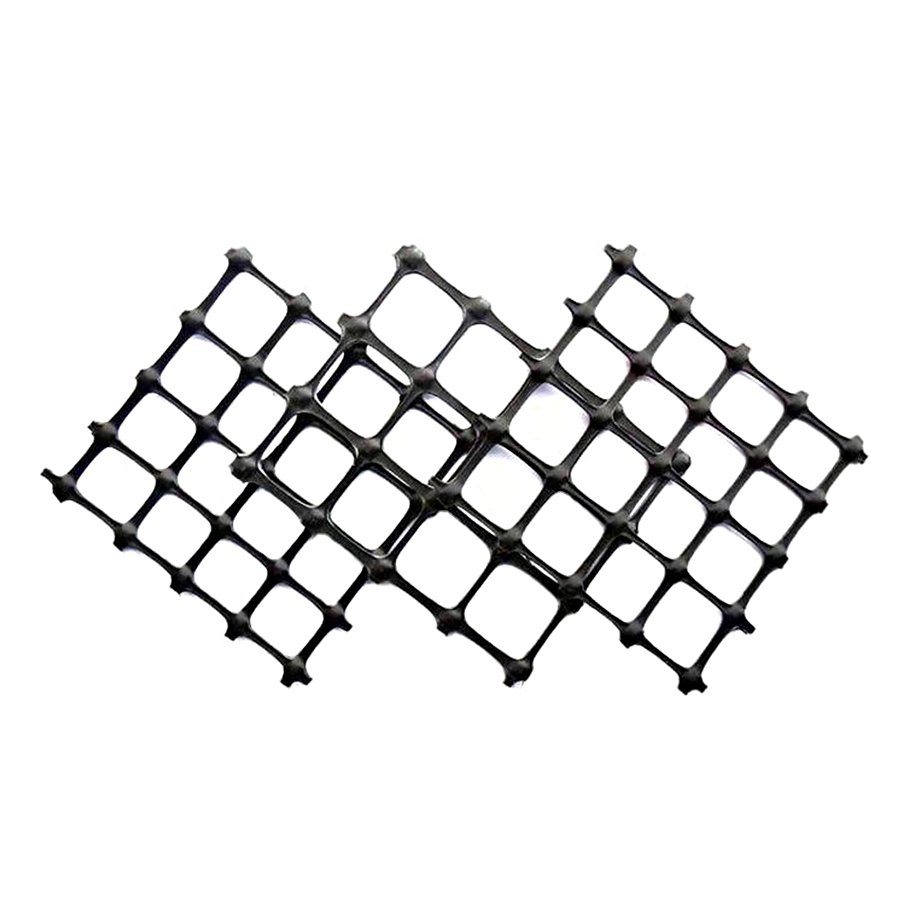
Biaxial Green Geogrid is a geosynthetic material made of polypropylene (PP) or high-density polyethylene (HDPE) as the main raw material, which is formed by extrusion, punching, and longitudinal and transverse stretching. Its structure is a regular mesh, with balanced tensile strength in both longitudinal and transverse directions, and uses environmentally friendly green pigments.
PP Biaxial Geogrid
PP bidirectional geogrid is a high-strength geosynthetic material made of polypropylene (PP) through extrusion, punching, heating, and longitudinal and transverse stretching. Its main function is to improve the bearing capacity of soil and enhance the stability of roadbed. It is widely used in various infrastructure construction.
Biaxial Plastic Geogrid
PP(Polypropylene) biaxial geogrid is manufactured from PP, it is produced through the process of extruding, punching, heating,longitudinal and transverse stretching.